Picking a patio material in Colorado is not the same decision as picking one in Texas or Georgia. Our climate sits in a category of its own: intense UV exposure at altitude, rapid temperature swings, and somewhere around 50 to 60 freeze-thaw cycles every winter. That combination breaks down some materials faster than homeowners expect. Here is an honest comparison of the four most common patio surfaces we see across Lafayette, Erie, Boulder, and the surrounding Front Range.
Interlocking Concrete Pavers
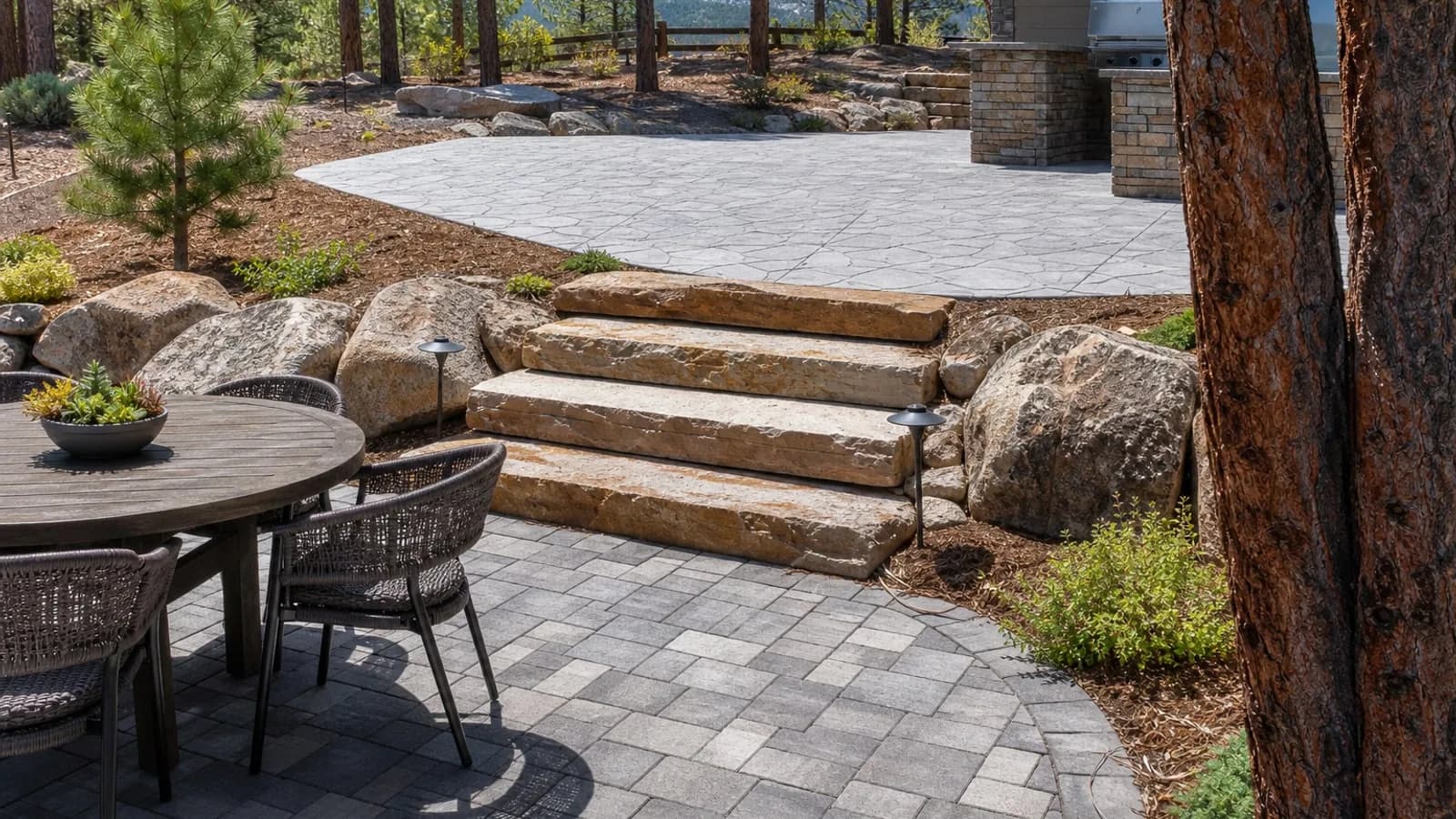
Interlocking pavers are individual units laid on a compacted aggregate base with sand-set joints. The key advantage for Colorado is flexibility. Each paver can shift independently with ground movement from freeze-thaw cycles without cracking. If one section heaves or settles, you can pull up those pavers, re-compact the base, and relay them. Try doing that with a cracked concrete slab.
Belgard pavers are engineered to exceed 8,000 PSI compressive strength, which is well above what standard poured concrete achieves. They also carry a lifetime material warranty when installed by an authorized contractor. Cost-wise, expect $15 to $35 per square foot installed, depending on design complexity and paver selection. Our paver installations page breaks down what is included in that range.
Pros: Handles freeze-thaw exceptionally well, repairable in sections, huge range of colors and patterns, lifetime warranty with Belgard.
Cons: Higher upfront cost than basic poured concrete, requires quality installation to perform correctly.
Poured Concrete
A standard poured concrete slab is the lowest-cost option at roughly $8 to $15 per square foot installed. It is functional and familiar. But in Colorado, plain concrete has a predictable problem: cracking. Concrete is rigid. When the ground shifts underneath it, the slab does not flex. It fractures. Control joints help direct where cracks form, but they do not prevent them.
Most poured concrete patios along the Front Range start showing hairline cracks within the first two to five years. That is not necessarily a structural failure, but it does affect the look and can worsen over time as water enters the cracks and freezes.
Pros: Lowest upfront cost, simple installation, clean appearance when new.
Cons: Cracking is nearly inevitable in Colorado, difficult and expensive to repair, limited design options.
Stamped Concrete
Stamped concrete is poured concrete with patterns and color pressed into the surface before it cures. It can mimic the look of stone, brick, or pavers at a lower price point, typically $12 to $25 per square foot installed. The aesthetics are appealing, which is why many homeowners are drawn to it.
The catch is durability. Stamped concrete has all the cracking problems of regular concrete, plus the added issue that the surface color and texture degrade over time. The topical sealer that gives stamped concrete its color depth needs to be reapplied every two to three years, and when it peels or wears unevenly the surface looks worse than plain concrete would. In our experience, stamped concrete in Colorado starts looking tired after about five to seven years. You can read more about this on our stamped concrete page, where we discuss when it makes sense and when pavers are the better call.
Pros: Better aesthetics than plain concrete, moderate cost, many pattern options.
Cons: Cracks just like poured concrete, requires regular resealing, color fades and wears unevenly, not repairable in sections.
Natural Flagstone
Flagstone is beautiful. There is no argument there. Natural stone laid in a patio creates a look that manufactured products cannot quite replicate. Costs range from $20 to $45 per square foot installed, depending on stone type, thickness, and whether you choose dry-laid or mortar-set installation.
The challenge with flagstone in Colorado is that many varieties are porous and absorb water. When that water freezes, the stone can spall, flake, or crack. Thicker cuts of denser stone like quartzite hold up well, but they are on the expensive end. Dry-laid flagstone on a gravel base handles freeze-thaw better than mortar-set flagstone on concrete, because it can flex similar to pavers.
Pros: Unmatched natural beauty, unique character, good longevity with proper stone selection.
Cons: Higher cost for durable stone types, uneven surfaces can be a tripping concern, more maintenance than pavers.
Our Recommendation
For most homeowners in Lafayette, Erie, Boulder, Westminster, and the surrounding area, Belgard interlocking pavers offer the best combination of durability, aesthetics, repairability, and long-term value. They are purpose-engineered for the kind of ground movement and temperature swings we deal with along the Front Range. The upfront investment is higher than basic concrete, but the lifetime cost is lower because you are not paying for crack repairs, resealing, or early replacement.
If you are weighing options for a new patio, contact us to schedule a design consultation. We will walk your property, discuss your goals, and give you a straight answer on what makes sense for your specific situation.
Frequently Asked Questions
What is the best patio material for Colorado freeze-thaw cycles? Interlocking concrete pavers handle Colorado freeze-thaw better than poured or stamped concrete because individual units flex with ground movement instead of cracking. Belgard pavers engineered for 8,000+ PSI compressive strength are a strong choice when installed on a properly compacted base.
Do concrete patios crack in Colorado? Most poured concrete patios along the Front Range show hairline cracks within two to five years because rigid slabs cannot flex when expansive clay soils swell and shrink. Control joints help direct cracks but do not prevent them.
Is stamped concrete worth it in Colorado? Stamped concrete looks good initially but shares poured concrete’s cracking problems and requires resealing every two to three years. Color and texture often fade unevenly after five to seven years, while pavers remain repairable in sections.