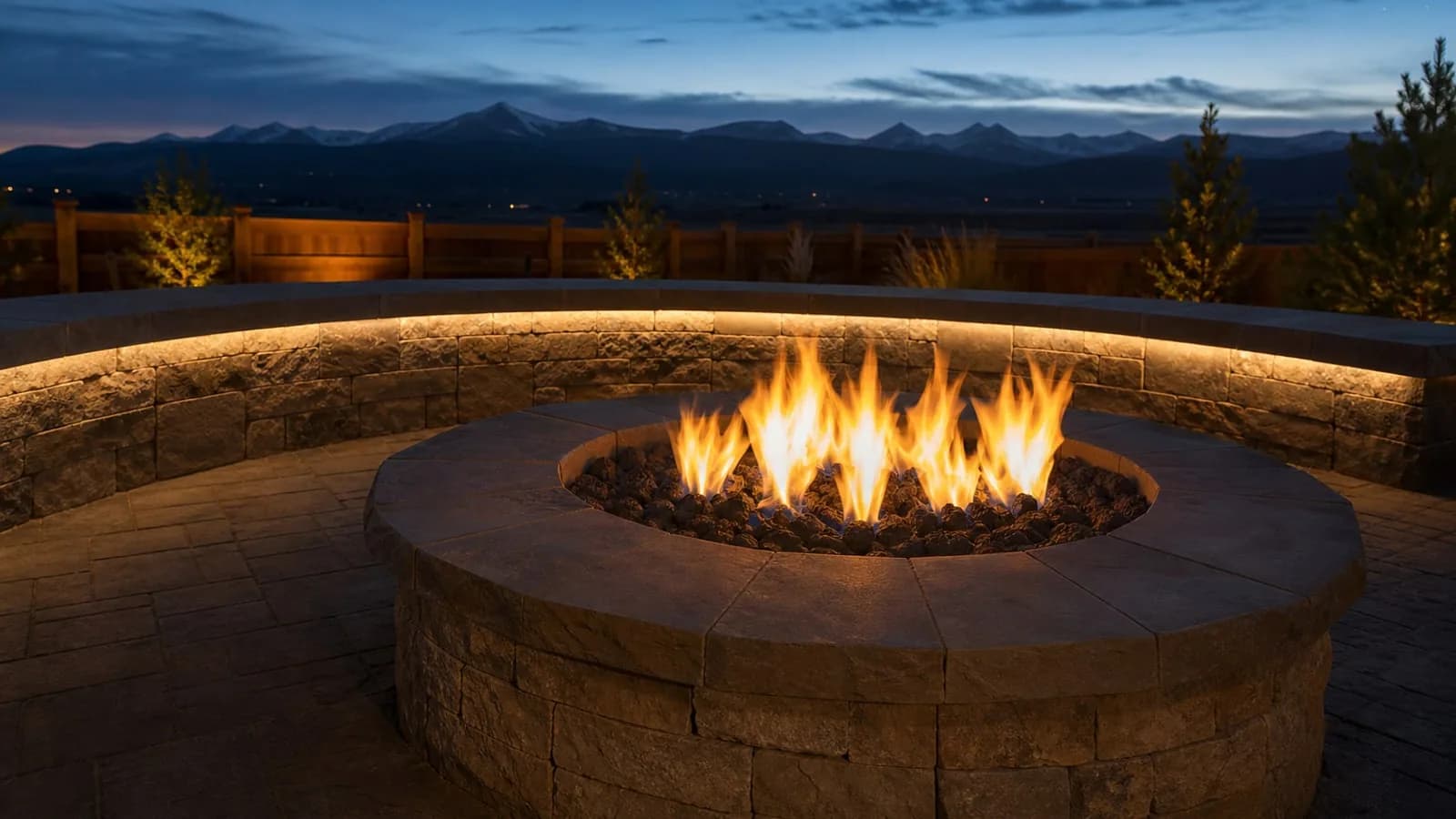
Colorado homeowners love their outdoor spaces, and a fire feature is one of the most popular additions we build. But the choice between a gas fire pit and an outdoor fireplace is not always obvious. Here is a clear-eyed comparison to help you decide.
Gas Fire Pits: Versatile, Social, Lower Cost
A gas fire pit sits in the center of a seating area, creating a social gathering point where people can sit on all sides. The fire is visible from every angle, and the open design makes conversation easy. Gas fire pits are generally less expensive to build than masonry fireplaces, easier to incorporate into a patio design, and faster to permit and install.
Our Warming Trends burner systems produce a full, beautiful flame and are available with hand-lit, electronic ignition, or Bluetooth remote start options. The flame can be adjusted for height, and color-changing glass media creates dramatic visual effects.
Best for: Social entertaining spaces, families with children who will gather around the fire, patios with seating on multiple sides.
Outdoor Fireplaces: Architectural, Dramatic, Higher Impact
An outdoor fireplace is an architectural feature, a statement piece that anchors one side of an outdoor room the way an interior fireplace anchors a living room. It creates a defined focal point and a sense of structure that a fire pit does not. Outdoor fireplaces also provide a heat-reflective surface that radiates warmth more directionally than a fire pit, making them somewhat more effective at warming a seating area in cool Colorado evenings.
The trade-off is cost and footprint. A masonry outdoor fireplace requires significantly more material and labor than a fire pit, and it occupies more space in your backyard design.
Best for: Formal outdoor rooms, properties with larger budgets, homeowners who want a dramatic architectural element.
Colorado Air Quality Considerations
Colorado's Front Range has air quality action days that restrict wood burning during certain weather conditions. Gas fire features, both fire pits and gas-burning fireplaces, are not subject to these restrictions and can be used year-round. If you want a wood-burning fireplace, confirm the regulations in your specific municipality before committing to that design.
Natural Gas vs Propane
Natural gas is ideal when we can route a licensed gas line extension to the patio edge efficiently. Operating cost per BTU is typically lower, and you never swap tanks.
Propane makes sense when the patio sits far from the meter, when trenching under established landscaping is undesirable, or when you need flexibility for a future layout change. We plan cabinet or bench enclosures so the tank stays out of sight and code-compliant.
Permitting and Safety Basics
Gas fire features require a licensed plumber for the fuel connection and often a mechanical permit depending on jurisdiction. Clearances to combustibles, venting for enclosed fireplace boxes, and shutoff accessibility are not places to improvise. We coordinate drawings and inspections as part of our fire pits and fireplaces scope.
Municipality-Specific Reality on the Front Range
“Colorado” is not one uniform code book. Denver, Boulder County towns, and northern suburbs handle gas-line offsets, property-line setbacks, and accessory structure heights differently for fireplaces versus pits. Properties along the Thornton–Northglenn corridor may see different mechanical inspection sequencing than a lot in Louisville or Superior. If wood is still on the table, rural-adjacent pockets near Mead–Berthoud are not the same conversation as a zero-lot-line home in Westminster. We run permit research for your exact address, not just your ZIP prefix, before we lock fuel type and footprint.
Our Recommendation
For most Colorado homeowners, we recommend starting with a custom gas fire pit integrated into a well-designed paver patio. The social versatility, lower cost, and regulatory simplicity make it the right choice for the majority of budgets and lifestyles. Homeowners who want a primary architectural feature for a formal outdoor room, or who have larger budgets and grand design visions, often love an outdoor fireplace.
Contact Rock N Roll Stoneworks to schedule a design consultation for your fire feature project.
Frequently Asked Questions
Is a gas fire pit cheaper than an outdoor fireplace in Colorado? Usually yes. A custom gas fire pit integrated into a paver patio typically costs less in materials and labor than a full masonry outdoor fireplace, though final price depends on size, stone facing, and gas line routing.
Can I burn wood in an outdoor fireplace on the Front Range? Sometimes, but many Front Range counties and municipalities restrict wood burning on air-quality action days. Gas fire features avoid those restrictions. Always verify local codes before committing to wood.
Natural gas or propane for a Colorado fire pit? Natural gas is convenient when a licensed plumber can extend your home line. Propane works well for remote patio locations or when trenching is impractical; it requires a concealed tank plan that we design into the layout.